USHER SYNDROME RESEARCH & TRIALS
Receiving a diagnosis of Usher Syndrome can feel overwhelming and, especially as there is currently no treatment of cure, can feel like a bleak future is mapped out before you. However, this is NOT the case. Despite being classified as a rare disease, there are already human trials and a huge amount of research being undertaken, which offer great hope for future treatments.
Given there are so many eye conditions, following advancements specifically relevant to Usher Syndrome can prove extremely challenging and naturally, for the majority of people, the science can be pretty baffling. Cure Usher is following closely the human trials into treatments for Usher associated sight loss, as well as tracking key research projects across the globe. These have been collated into a database, and updates will be reported as they appear in the scientific press.
The rapid advancements in stem cell technology, gene therapy, A.I and others offer great hope to those suffering from Usher Syndrome, no matter what stage of the disease a person is at. Treatments ARE coming, the science is there but, as always, funding is a huge challenge and any donations will only serve to speed up treatment delivery.
OUR COLLATED RESEARCH
Below is an Excel file containing all of our collated research in one easy to access format. This file will be updated on a regular basis as new research develops.
GENE VISION SUPPORT
Gene Vision has excellent supporting documentation for anyone with Usher Syndrome. We’ve provided a link below to all of their excellent information.
BREAKING NEWS
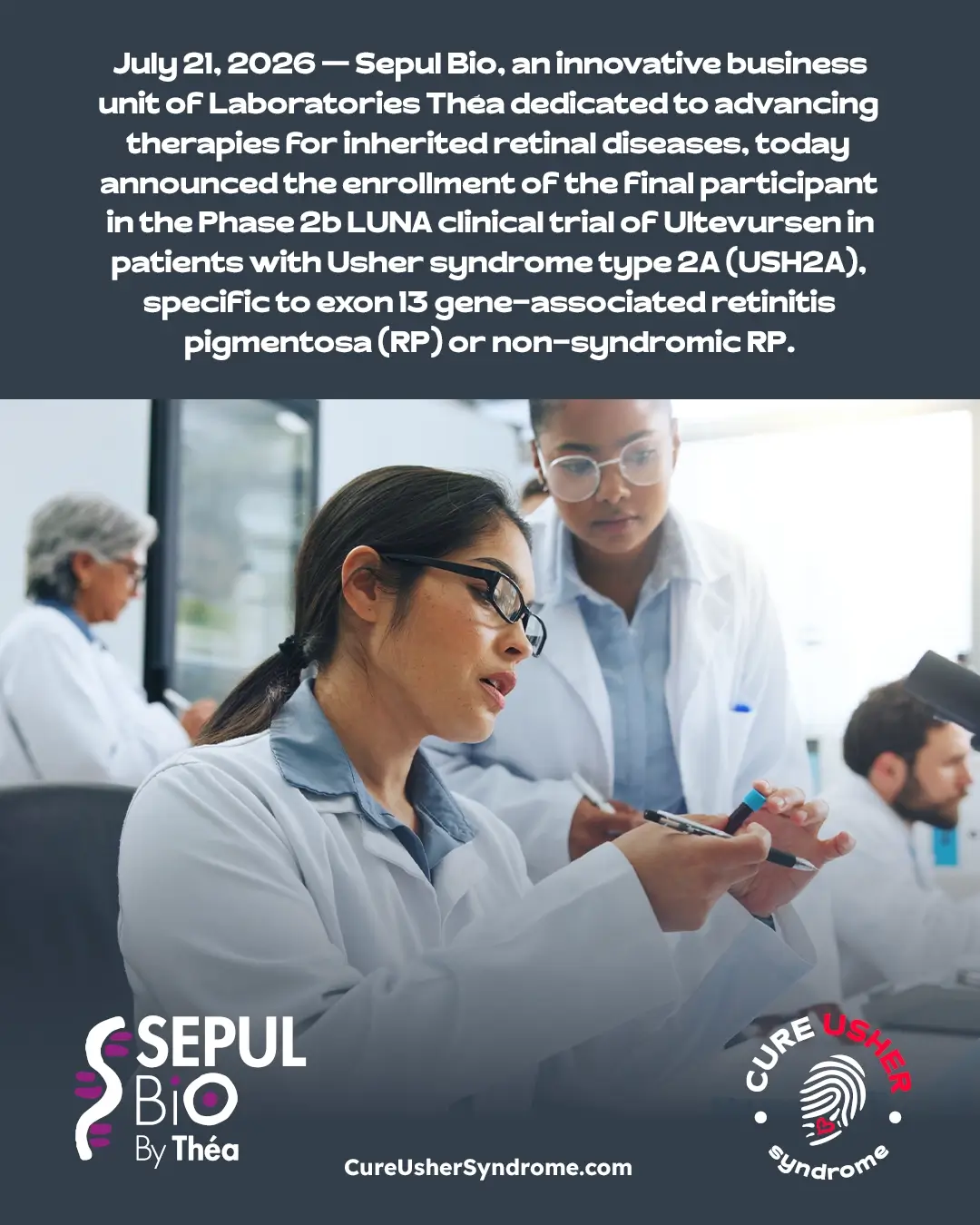
Clermont-Ferrand, France – July 21, 2026 — Sepul Bio, an innovative business unit of Laboratories Théa dedicated to advancing therapies for inherited retinal diseases, today announced the enrollment of the final participant in the Phase 2b LUNA clinical trial of Ultevursen in patients with Usher syndrome type 2A (USH2A)-associated retinitis pigmentosa (RP) or non-syndromic RP.
“Achieving the enrollment of the final participant in the Phase 2b LUNA clinical trial represents a fantastic milestone for USH2A research,” said Dr. Robert Koenekoop, MD, PhD, Professor in the Department of Pediatric Surgery at the Faculty of Medicine and Health Sciences, McGill University.
“This moment takes us one step closer in our search for therapies for this condition of high unmet need. The LUNA clinical trial, being conducted across 26 active clinical sites in 10 countries, is exploring the impact of RNA therapies on individuals with USH2A-associated RP due to variants in exon 13 of the USH2A gene.”
“We are thrilled to see the full enrollment of the LUNA clinical trial,” said Krista Vasi, MPA, Executive Director of the Usher Syndrome Coalition.

RESEARCH NEWS
On January 21, 2025, Nacuity announced that its investigative therapy, NPI-001, has received both Fast Track Designation and Orphan Drug Designation from the U.S. Food and Drug Administration (FDA).
NPI-001 is a unique form of N-acetylcysteine amide (NACA) tablets that help reduce oxidative stress, which is linked to RP and other diseases. Oxidative stress happens when there is an imbalance or too many naturally occurring free radicals in the body. In small amounts, free radicals can be beneficial; however, when they accumulate, they can harm our cells and contribute to disease progression. Fast Track Designation means that NP-001 can be reviewed faster and might get approved quicker, so it can be available to patients sooner.
Orphan Drug Designation designation provides several benefits, like seven years of exclusive rights to sell the drug in the U.S., possible tax credits for eligible clinical trials, waivers for certain regulatory fees, and support to speed up the development process.
For Usher syndrome, Nacuity’s NPI-001 treatment has the potential to slow the progression of Usher syndrome related RP, no matter what the genetic mutations are.
UCL USHER SYNDROME RESEARCH
Cure Usher are proud to fund current leading research projects in the UK.
At present we have an agreement with University College London (UCL), to DIRECTLY fund Professor Mariya Moosajee MBBS BSc PhD FRCOphth, Professor of Molecular Ophthalmology at UCL Institute of Ophthalmology, for her groundbreaking work on Usher syndrome.
Quarterly payments are made with the proceeds direct from fundraising efforts that you all donate, empowering a meaningful difference in the search for a cure.
“I have had a close relationship with Cure Usher for the past 3 years.
The important work they are doing as a charity for the Usher community is invaluable, raising awareness and funding research to ultimately find a treatment that can help stabilise, prevent further sight loss or even improve vision.
In the last couple of years, they have raised awareness on a completely new and groundbreaking level. Our working relationship is vital to the research that I am currently undertaking.
Cure Usher is directly funding my work to develop a gene therapy for Usher syndrome that does not use viruses and has the capacity to hold the large Usher disease genes, if this approach is successful it will be applicable to all types of Usher syndrome. I truly believe the future holds promise for a treatment for individuals with this condition.
The talent is there, the science is there, the funding is not. We would be so grateful if you could donate to this important cause.”
-Professor Mariya Moosajee MBBS BSc PhD FRCOphth

DONATE & SUPPORT
Currently, there is no cure for Usher Syndrome.
Your generous donations are helping to find a cure for Usher Syndrome, as well as supporting people with Usher Syndrome & their families.
You can donate and support us through various methods including: JustGiving, Enthuse and direct via Bank Transfer.
Thank you again for all of your support.
The Cure Usher Team.